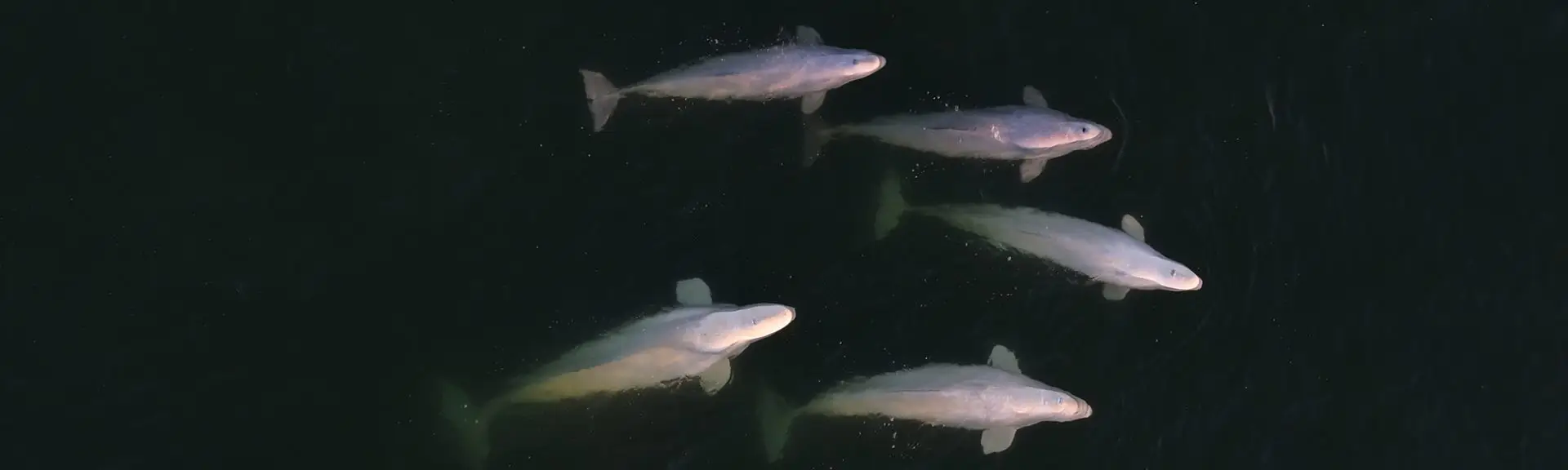
Belugas were once plentiful in Kotzebue Sound. More than 1,000 belugas returned to Kotzebue Sound annually and beluga hunting was a central part of the subsistence culture. Beluga harvest in the northern part of Kotzebue Sound collapsed prior to the 1970s. After the mid-1970s, beluga hunting mainly occurred in southern Kotzebue Sound, at Elephant Point. Data collected between 1977 and 1984 suggests that the beluga harvest was variable but large, averaging 84 whales per year during 1977-1983 (maximum of 154 in 1982). The harvest collapsed in 1984 and has yet to recover. Since 1990, harvest has averaged 15 per year (< 10/year in 23 of the last 30 years; ABWC unpubl. data).

Genetics data show that a unique population of belugas frequented Kotzebue Sound prior to the collapse. Since 1984, it appears that sometimes there are belugas from other populations in Kotzebue Sound. Belugas harvested during high harvest years in 1996 and 2007 were from a different population, likely the Beaufort Sea population (see Greg O’Corry-Crowe’s paper on beluga stock structure in Kotzebue Sound).
Attempts to recover the Kotzebue beluga population have been spearheaded locally, by beluga hunters in Kotzebue Sound (see Kotzebue Sound History). These attempts began in the late-1990s and a Regional Beluga Plan for Kotzebue Sound was first proposed in 2001 and a draft plan was completed in 2016 and revised in 2017, 2018, 2020. The final plan (Tribal Kotzebue Sound Beluga Plan) encouraged no hunting in June or July (when Kotzebue Sound belugas are traditionally present), no hunting of females with calves, no use of nets, and no hunting in safe zones in Selawik and Kobuk lakes, Goodhope Bay, Kiwalik Lagoon, and Eschscholtz Bay. This plan was signed by the communities of Buckland, Deering, Kivalina, Kotzebue, and Noatak. In spite of the plan being signed, many hunters did not follow the plan. Seeking a way forward, ABWC approached NOAA for help. NOAA did not recognize belugas in Kotzebue Sound as being a distinct population. In 2024, ABWC requested NOAA consider giving belugas in Kotzebue Sound stock status (see letter to NOAA from ABWC and ABWC motion to designate Kotzebue Sound belugas as a Demographically Independent Population and a Stock, passed on 17 December 2025.
Prior to giving a population of belugas stock status, NOAA first considers if a group of belugas is distinct from other groups. NOAA calls these distinct groups Demographically Independent Populations (DIPs). As part of this consideration, NOAA reviews all available evidence, including Indigenous Knowledge, beluga distribution and movements from satellite telemetry and aerial surveys, genetic studies, and acoustic studies. In February 2026, NOAA released a report titled: Evaluation of Beluga Whales in Kotzebue Sound, Alaska, as a Demographically Independent Population (link here). This report concluded that: “1) during the historical time period a Kotzebue Sound DIP existed based on Indigenous Knowledge, harvest/sightings, and genetic lines of evidence, and 2) Indigenous Knowledge supports the existence of a contemporary DIP, but other lines of evidence do not support or refute the existence of a contemporary DIP.” In other words, NOAA concluded that many lines of evidence supported the idea that Kotzebue belugas were their own population before the 1980s and that beluga hunters thought those same belugas still enter the sound in spring.
Based upon that report, NOAA is currently considering if belugas in Kotzebue Sound warrant being categorized as a DIP and a stock. At their 2025 Annual Meeting, the ABWC made a resolution to support designating belugas in Kotzebue Sound as a DIP and a stock (link here) and sent a letter to NOAA reaffirming their support for designating belugas in Kotzebue Sound as a DIP and a stock (link here).